Why do perforations need acoustic backing?
Perforations let sound through the metal face to an absorber behind it, where air movement in the porous layer turns sound energy into heat. Face pattern, backing, cavity and mounting work as one system; an unbacked perforated sheet absorbs far less.
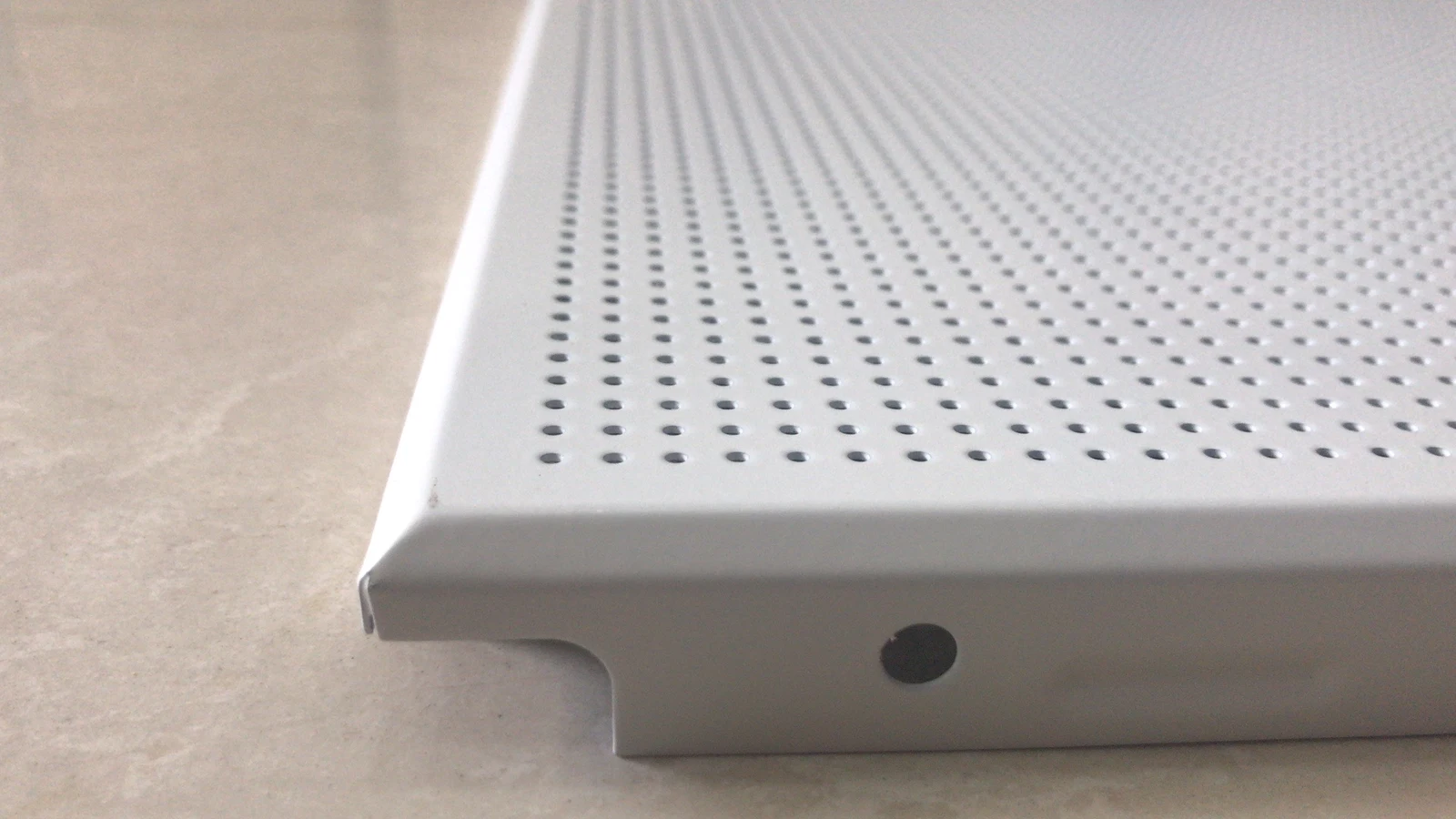
Lianhui’s perforated acoustic ceiling panels have hole diameters of Ø3–25 mm, 10–45% open area, solid borders of at least 20 mm and optional factory-bonded acoustic nonwoven fleece. Order the backing as part of the panel, not as a word in the finish description.
Changing the backing, covering it with an impervious layer or changing the cavity changes the acoustic result, even when the face looks identical.
Which acoustic rating answers the buyer’s question?
| Buyer’s objective | Relevant measure | What the number describes |
|---|---|---|
| Reduce echo within a room | NRC or frequency-dependent absorption data | Sound absorption by the tested ceiling construction |
| Limit sound between rooms through a shared ceiling plenum | CAC | Sound attenuation through a ceiling–plenum–ceiling path |
| Evaluate a separating wall or another single barrier | STC | Airborne sound transmission through the tested separating element |
NRC averages absorption at 250, 500, 1,000 and 2,000 Hz; CAC measures sound passing through a shared ceiling plenum. Use absorption data for echo control and isolation data for room-to-room privacy.
Why can speech still travel above a suspended ceiling?
A partition that stops at the ceiling leaves a path through the void: sound goes up on one side and comes down on the other, plus through gaps around services. A different ceiling panel does not close those paths.
For offices and meeting rooms, detail the partition head, a plenum barrier where required, its sealing and junctions, and service penetrations, and assess isolation for the complete construction.
| Room problem | Main path to address | Construction response |
|---|---|---|
| Speech and general noise linger within one room | Repeated reflections from hard surfaces | Use absorptive ceiling coverage and coordinate the other room finishes. |
| Speech passes between rooms below a shared plenum | Ceiling–plenum–ceiling transmission | Use a separating construction with the relevant attenuation performance. |
| Sound travels through gaps at the partition head or services | Open or poorly sealed junctions | Complete the partition junction and treat service penetrations. |
| Sound passes through a door or wall | The separating element and its junctions | Address that path; replacing only the ceiling face leaves it in place. |
What exactly belongs in a perforated-ceiling quotation?
- The room objective: echo control, room-to-room isolation, or both.
- Perforation pattern (hole size, pitch, open area) and solid borders.
- Backing material, thickness and position behind the face.
- Suspension depth and any extra insulation or plenum barrier.
- Acoustic data tied to the tested assembly, including backing and mounting.
In open receptions and dining areas, absorption is the main ceiling task. For a meeting room next to an office, the partition and plenum junctions matter as much. For open baffle ceilings, use data for the tested baffle arrangement.
Lianhui bonds the acoustic fleece in the factory when it is specified, so list it on the order with panel format, perforated field, border and mounting. Learn how to calculate perforated open area.
Compare assemblies on the same basis: NRC is a single-number absorption summary, a frequency table shows where absorption happens, and CAC covers the plenum path. Neither NRC nor open area is a decibel reduction you can subtract from a room level.
Does adding more holes always improve the room?
More open area changes how the face works with the backing, but the room result also depends on absorber coverage, room volume, furnishings and other hard surfaces. Compare complete assemblies at the frequencies that matter for the space.
Which package solves your room’s problem?
For echo in a reception, dining area or hall, buy the perforated face with absorptive backing and coordinate the treated area with the room design. For privacy between enclosed rooms, add the separating construction at the partition head and plenum as well.
When comparing finishes or quotations, keep the acoustic assembly fixed; changing color or finish is simple as long as backing and mounting stay the same. Lianhui finishes perforated panels in powder, PVDF or wood-grain from an MOQ of 150–200 m².
Buying in volume? Standard ceilings ship from 150–200 m² in 15–20 working days. Get wholesale prices → · Custom project? Send drawings →