What does the extra 0.5 mm actually change?
Plate bending rigidity is D = Et³ / [12(1 − ν²)], where E is elastic modulus, t is thickness and ν is Poisson’s ratio. Because rigidity rises with the cube of thickness, a small thickness increase gives a large stiffness gain.
| Quantity | 2.5 mm reference | 3.0 mm comparison |
|---|---|---|
| Sheet thickness | 2.5 mm | 3.0 mm |
| Mass per unit area | 1.00 | 3.0 / 2.5 = 1.20 |
| Ideal plate rigidity | 1.00 | (3.0 / 2.5)³ = 1.728 |
| Small-deflection response under the same load and supports | 1.00 | 1 / 1.728 ≈ 0.579 |
So a 3 mm flat sheet deflects about 42% less than 2.5 mm under the same load and supports. Brackets, anchors, stiffened folded panels, strength and local buckling are checked separately.
Why can panel size matter as much as thickness?
Under the same pressure and supports, plate deflection scales with span to the fourth power and inversely with rigidity. Cutting the span to 90% cuts that term to 0.9⁴ = 0.66, so splitting a wide panel or adding a support can beat a thickness change and cost less.
Real panels have folded returns, discrete fixings and often rear stiffeners. Use the effective span between the parts that actually restrain the sheet, and show stiffener sections, attachments, cut-outs and perforations on the panel drawing.
Which Lianhui solid-panel options are available?
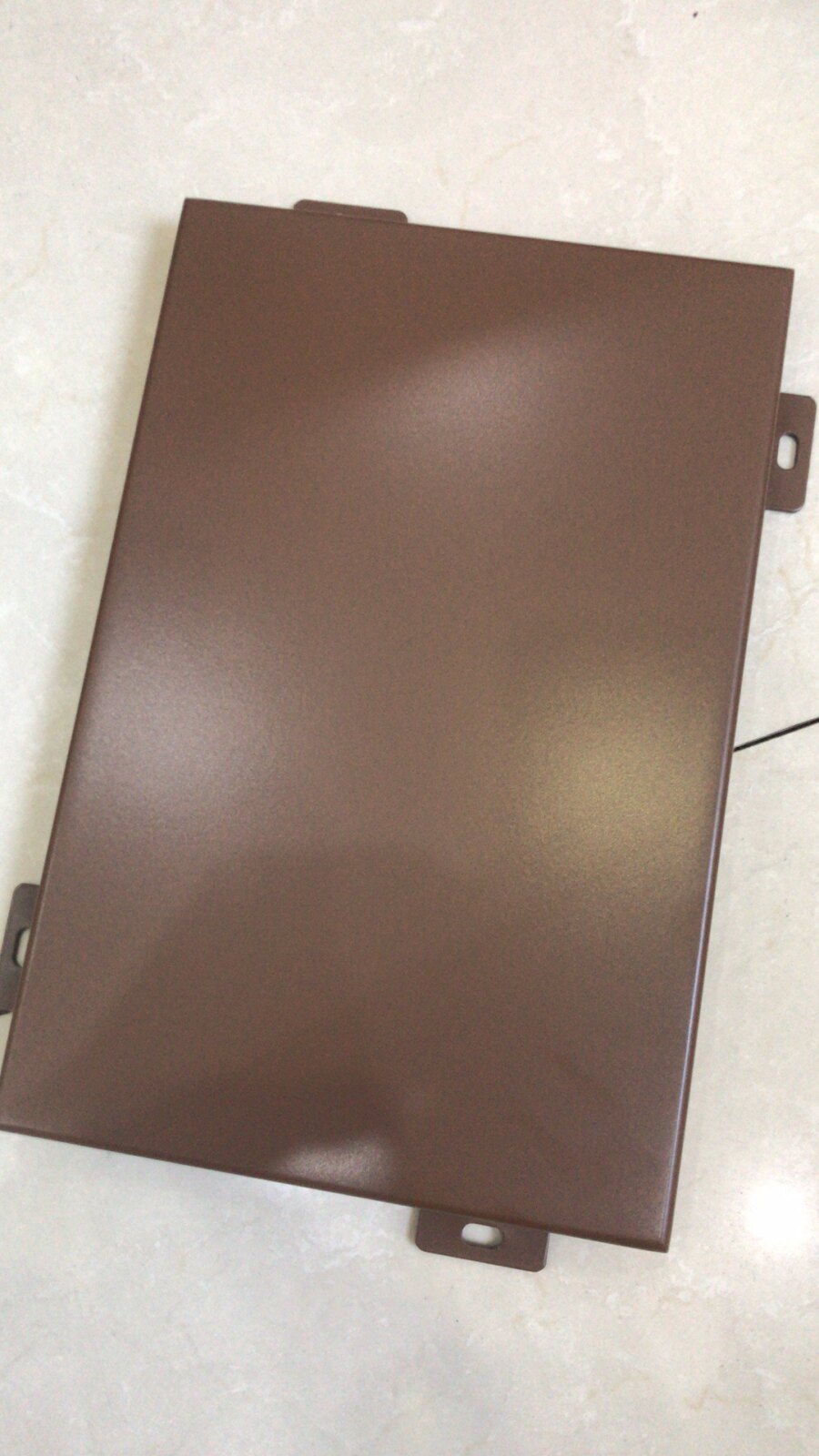
Lianhui’s custom solid aluminum panels come in 1.5, 2.0, 2.5 and 3.0 mm, AA1100 standard and AA3003 on request, in panels up to 4,000 mm long (a fabrication limit, not an unsupported span). Finishes are powder, PVDF or wood-grain; MOQ is 150–200 m² and production 15–20 working days.
By weight, 2.5 mm AA1100 sheet is about 6.78 kg/m² and 3 mm about 8.13 kg/m², which also affects freight and handling. Clip-in ceiling panels, ACP and honeycomb panels are different constructions, so their nominal thickness does not compare directly with solid 3 mm. See solid aluminum vs ACP vs honeycomb.
How are facade loads carried into the building?
Wind pressure and suction travel from the face through returns and stiffeners into the panel fixings, then through the subframe and anchors to the structure. Each link needs its own capacity; thicker sheet does not strengthen an anchor.
Coordinate pressure zones, fixing positions and thermal movement in the facade design, keep sliding connections free to slide while fixed points carry load, and size joints and sealant for the movement. See the expansion joint calculation.
How should 2.5 and 3 mm proposals be compared?
Compare the same face size, alloy and temper, returns, stiffeners, fixing schedule and design loads, and assess structural behavior and visual flatness separately against agreed criteria.
Keep 2.5 mm where the designed assembly passes; move to 3 mm, smaller panels or extra supports where deflection or strength governs. List the complete assembly, finish, stiffeners and fixings on the purchase schedule so every quote covers the same scope.
Questions buyers ask
Does 3 mm mean the panel can carry 73% more wind load?
No. The 73% figure is the ideal plate rigidity increase for unchanged material properties. Allowable load is governed by the complete panel, connections, support frame and the applicable strength and serviceability criteria.
Should coating thickness be included in the metal thickness?
Specify the aluminum substrate and coating separately. The 2.5 or 3 mm comparison concerns the structural metal sheet; coating type, color and film thickness belong in the finish specification.
Buying in volume? Standard ceilings ship from 150–200 m² in 15–20 working days. Get wholesale prices → · Custom project? Send drawings →