Why does aluminum develop water staining in a closed pack?
Water trapped between tightly packed aluminum surfaces cannot evaporate and leaves uneven oxidation stains. Receive panels in a dry area and deal with moisture inside packs straight away.
A cold pack moved into warm, humid air also condenses: the metal is below the air’s dew point. An intact outer wrap does not remove moisture already inside.
On coated cladding, the coating system sets the allowed cleaning and recovery method; abrasive cleaning can damage the finish.
Step 1: How should the delivery be received?
| Condition at arrival | Receiving action | Storage action |
|---|---|---|
| Dry, intact package | Check panel marks and package condition | Keep dry on level, supported bearers |
| Wet or torn wrapping | Photograph the affected package and inspect its contents | Separate affected material for drying and condition assessment |
| Cold pack entering a warm building | Avoid immediate exposure to humid air | Allow the closed pack to reach a stable temperature in a dry area |
| Bent edge or damaged corner | Record the panel identification and damage | Keep it apart from installation-ready panels |
Shipping packaging protects panels in transit; it is not an outdoor shelter. Plan delivery into a dry receiving space rather than leaving crates beside an open facade.
Step 2: How should panels be supported and identified?
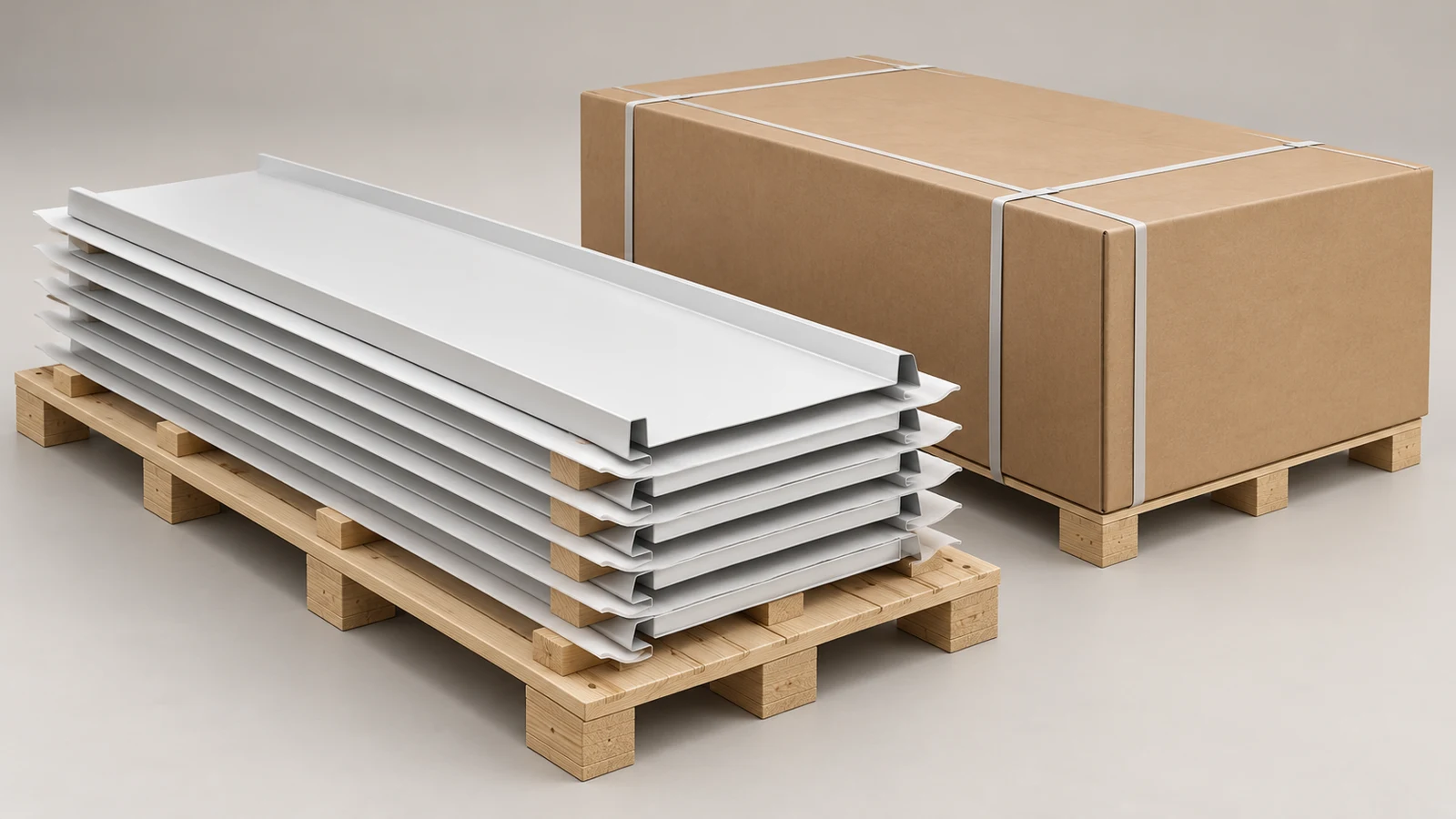
Keep packs stable, level and supported without loading folded returns or faces. Keep clean separators in place, lift panels instead of dragging face over face, and keep grit, wet timber and dust away from contact surfaces.
Lianhui’s custom solid aluminum panels include folded, curved and irregular shapes in 1.5–3.0 mm sheet, and long or shaped pieces need more support points than small flat ones. Lianhui packs panels with peel-off film, EPE foam or bubble wrap and corner guards, in plywood crates for LCL; use the support positions of that packing and keep the panel sequence.
Put labels where installers can read them without unstacking, and link each pack to elevation, floor or zone. Keep rejected and replacement pieces apart from ready-to-install stock.
Step 3: When should protective film be removed?
Protective film is temporary. Keep filmed panels out of prolonged sun and heat, store them indoors in a dry, ventilated place, and peel the film at the right installation stage, before it traps site dirt or becomes hard to remove.
Write the film’s removal period on the delivery and installation documents and schedule removal within it.
Step 4: What should happen to wet or damaged panels?
A dry outside does not mean dry interfaces. Open affected packs under cover, inspect faces and separators, dry them without scraping or rubbing the coating, and set stained or damaged pieces aside.
| Observed condition | Action | Before installation |
|---|---|---|
| Moisture between faces or separators | Separate and dry in a protected area using non-damaging handling | Interfaces are dry and the faces have been inspected. |
| Dirt or residue on the coating | Use the coating system’s approved cleaning method | The face is clean without abrasion or coating damage. |
| Bent return, damaged fixing point or distorted panel | Set aside from installation-ready stock | Repair or replacement restores the specified geometry and connection. |
| Film beyond its instructed removal stage | Remove according to the film/coating instructions | No trapped contamination or adhesive damage remains. |
How should the purchase plan reduce storage damage?
Match delivery batches to the installation sequence and the dry storage available, and include pack labels, lifting and support arrangements, film instructions and a receiving inspection record.
Where site storage is tight, order staged deliveries by zone, and budget for handling and protected storage in the site costs. Ordering a few spare panels from the same finish batch covers handling damage; see how many spare panels to order.
Check package size against the route with the large panel delivery guide.
Buying in volume? Standard ceilings ship from 150–200 m² in 15–20 working days. Get wholesale prices → · Custom project? Send drawings →