
Why are installation allowance and maintenance spares different?
Installation allowance covers cutting, handling damage and pieces used up during installation. Maintenance stock is the usable inventory handed to the building operator. Merge them into one percentage and the site team uses up the panels meant for later repairs.
List the two quantities separately on the order and handover schedule, and count only complete, undamaged panels as maintenance stock.
What makes two ceiling panels interchangeable?
A spare must fit the carrier and match the face: module, actual dimensions, edge profile, thickness, finish and color, perforation and backing, and any holes or special returns. Give each non-interchangeable variant its own stock code.
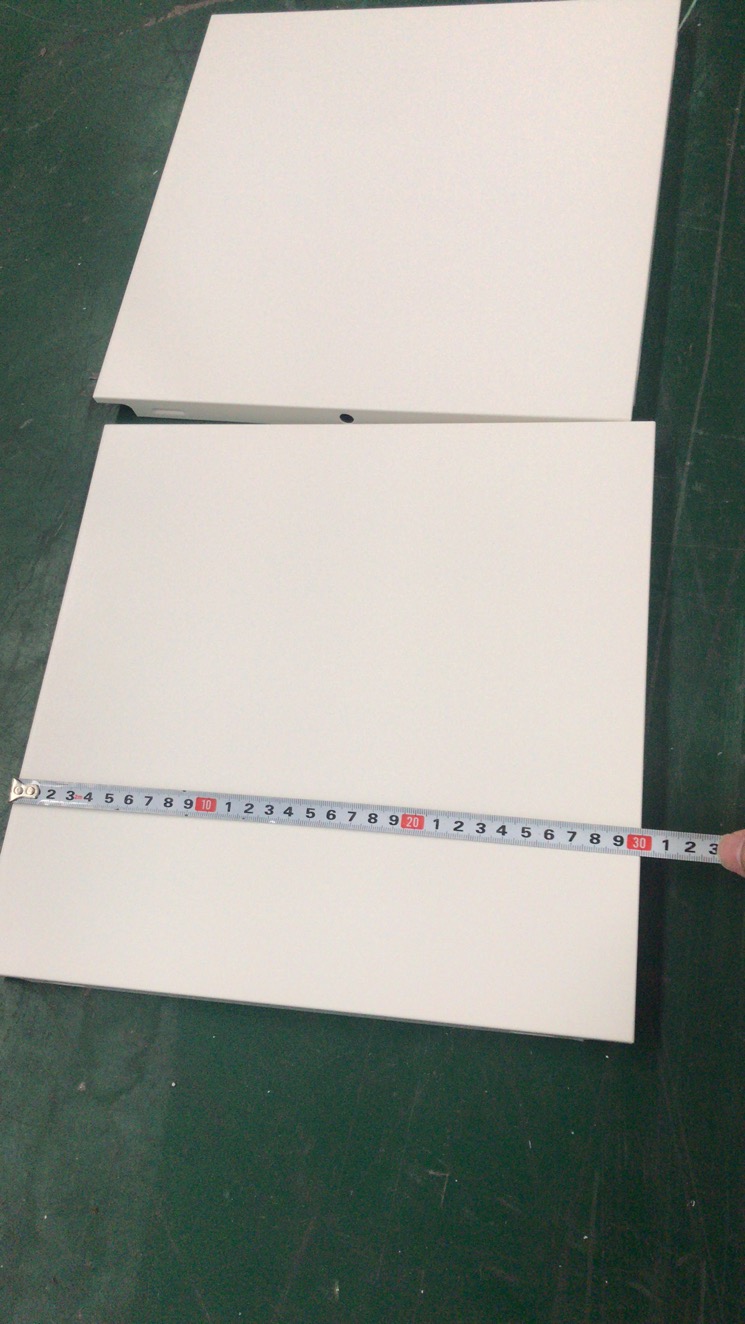
Lianhui’s high-edge clip-in panels come as a 600 × 600 mm module with a 25 mm edge and a separate 30 mm-edge series; the same module size does not mean the same carrier. Keep the approved panel-and-carrier pair in the spares record.
| Difference | Why it matters at replacement | Stock rule |
|---|---|---|
| 25 mm versus 30 mm formed edge | Carrier engagement is part of the system geometry | Use separate stock codes tied to the matching carrier. |
| Plain versus perforated face | Appearance and the specified acoustic construction differ | Retain the specified perforation and backing arrangement. |
| Standard field panel versus factory-formed perimeter | A cut edge does not reproduce a folded or retained return | Stock the special perimeter part where required. |
| Light, sprinkler or service cutout | Hole size and position are part-specific | Identify the cutout drawing or keep suitable uncut stock with an approved cutting method. |
| Same color name, different production batch | A later replacement can differ visibly from adjacent panels | Retain original-batch stock and the finish reference. |
How is a useful spare quantity calculated?
Per stock code: handover spares = replacements expected before replenishment + reserve for one more event. Replenishment time matters because stock must last from using a spare until its replacement arrives.
Take 600 field panels and 12 special perimeter panels. Four expected field replacements plus two reserve = six field spares; one perimeter replacement plus one reserve = two perimeter spares. Total: eight usable panels across two stock codes.
| Stock code | Installed quantity | Planned replacements before replenishment | Additional reserve | Handover stock |
|---|---|---|---|---|
| Standard field panel | 600 | 4 | 2 | 6 |
| Special formed perimeter panel | 12 | 1 | 1 | 2 |
| Total | 612 | 5 | 3 | 8 |
Show any pack-size rounding on the purchase order. After handover, record actual withdrawals and reorder time, and adjust stock for parts that are used up faster or not at all.
Why order replacement stock with the original ceiling?
The original order is the easiest time to match finish and fabrication. Color, gloss, texture and wood-grain direction can give away a later replacement even under the same color name. Store the finish reference and batch number with the spares.
Lianhui produces spares in the same coating run as the main order when they are listed on it. For later replacements, match panel series, edge profile, carrier and finish sample on the spare-parts schedule.
What should be handed to the maintenance team?
- Count of undamaged panels by stock code, with storage locations.
- Panel drawing, edge section and matching carrier reference.
- Finish and batch references, including grain direction.
- Cut-out drawings and labels for special perimeter or service panels.
- Removal and refitting procedure, with the right removal tool.
Store spares supported, clean and dry with edges protected, in their original packing, and link the inventory to the ceiling layout so the right part is found quickly. The panel storage guide covers moisture, handling and surface protection.
Common purchasing questions
Can a larger spare panel be cut down for every opening?
No. Cutting can create a face dimension, but it does not recreate a factory-folded edge or the engagement required by a concealed carrier. Use cut stock only where the installation detail permits that cut edge and provides its required support.
Should a water-stained or damaged panel simply be replaced?
Remove the cause first. A leak, damaged carrier or obstructed removal route will damage the replacement or prevent correct installation. Restore the assembly and then fit the matching spare.
What is the final order requirement?
List installation allowance and maintenance stock as separate quantities, split maintenance stock by interchangeable part, and require a counted handover. This produces a usable replacement inventory instead of an arbitrary extra percentage.
Buying in volume? Standard ceilings ship from 150–200 m² in 15–20 working days. Get wholesale prices → · Custom project? Send drawings →