What connects the baffle above the visible face?
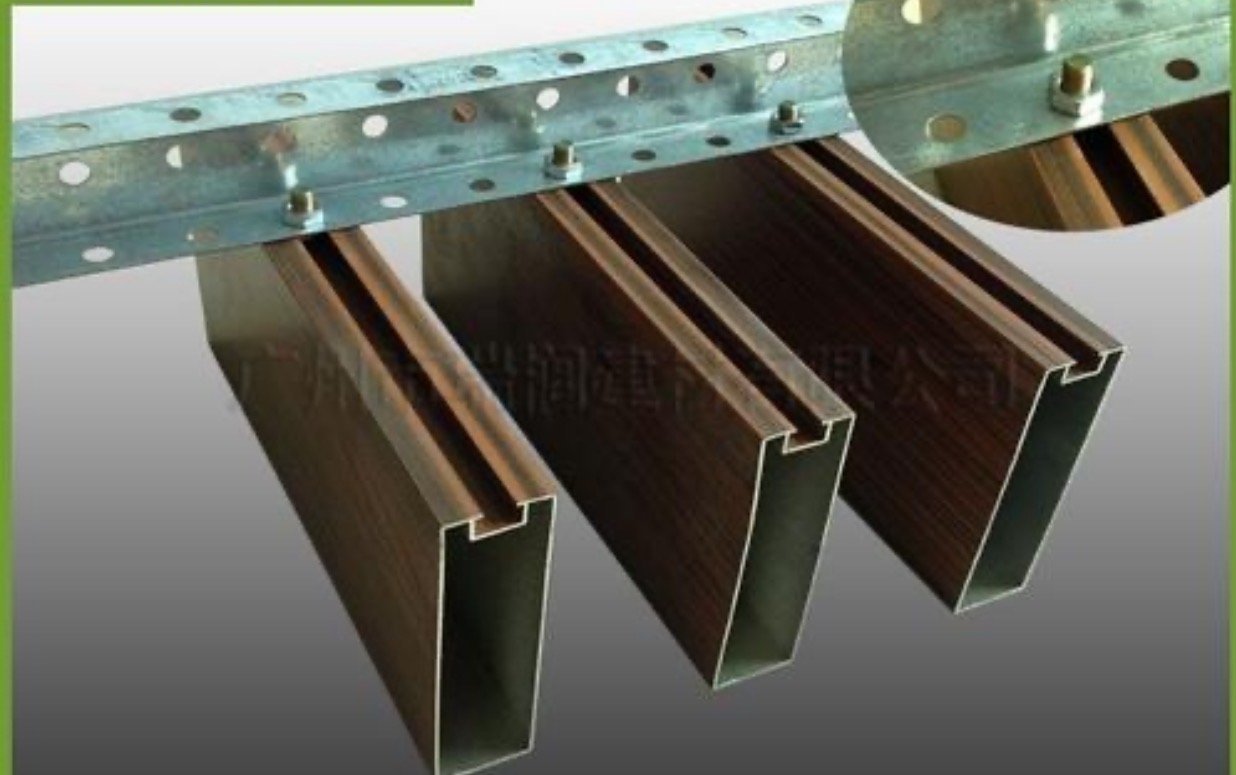
Two baffles can give the same ceiling line and still need different carriers. A folded U-section is open at the top and clips into a toothed carrier; a rectangular tube uses its own hanger or a bolted connection. That hidden connection decides which carrier goes on the order.
Lianhui’s 25 × 80 mm folded U-baffle is made in 0.50–1.00 mm sheet, and the 25 × 80 mm rectangular tube in 0.7, 0.8, 0.9 or 1.0 mm wall. Same outside size, same 0.8 mm option, different carriers.
| Lianhui assembly | Connection to identify | What must appear in the supply schedule |
|---|---|---|
| Folded U-baffle, horizontal-tooth system | Baffle engages the matching toothed carrier; strip hangers connect that carrier to the main framework | U-section, carrier and strip-hanger references |
| Combined U-baffle, vertical-tooth system | Different carrier arrangement with a separate cover profile | Baffle, vertical-tooth carrier and cover as one matched set |
| 25 × 80 mm rectangular profile | Dedicated hanger engages the top slot | Profile section, slot detail, dedicated hanger and matching carrier |
| 30 × 100 mm rectangular profile, illustrated bolted arrangement | M6 hex bolts connect to a No. 40 secondary carrier | The specified profile, bolt arrangement and secondary carrier |
How do you verify fit with a section drawing and a matched sample?
Ask for a section through the engagement point showing the top opening or slot, the clip or hanger shape, the seating position and any retaining part. For bolted assemblies, show hole position, fastener and tool access. The component references on the section should match the quotation and packing list.
Run a trial assembly with the finished profile and its matching parts. Check that everything seats fully, retaining parts fit, the face sits at the right level, and the baffle installs and removes by the stated method without force.
The trial proves fit and sequence. Spans, hanger points, anchors and extra loads come from the approved project design.
How do face width, clear gap and centre pitch differ?
For equal baffles, centre pitch p = b + g: visible width plus clear gap. A 30 mm face with a 100 mm gap gives a 130 mm pitch; a 100 mm pitch with the same face leaves a 70 mm gap. Always say which one “100 mm spacing” means.
A run of n baffles spans n × b + (n − 1) × g from outside edge to outside edge. Ten 30 mm faces with nine 100 mm gaps take 1,200 mm before perimeter margins.
Dimension the first and last baffle from the same room datum and show cut ends, intersections and direction changes, so the repeat does not leave a narrow strip at the wall.
How do you check the removal route alongside lights and services?
Draw the movement needed to unclip a baffle. Lights, ducts, wall returns or the next run can block it even when they clear the installed position. Check one typical area and every unusual junction, including tool access for bolted connections.
Keep ceiling supports and service supports separate; fittings hang from their own designed supports.
Order baffles, carriers, modules and spans as one coordinated system, using the drawings and data for the selected product.
Why keep a trial-assembly record with the order?
Label the sample assembly with profile reference, thickness, coating, hanger or clip reference, carrier reference and drawing revision, so the installer can rebuild it from the delivered parts.
| Check | Record during the trial | Hold the release if… |
|---|---|---|
| Engagement | Photograph the seated connection from the end and side | The profile needs force or an unapproved alteration |
| Retention | Identify and fit each specified retaining part | A required part is missing or cannot be reached |
| Removal | Describe the disengagement movement and tool access | Adjacent work blocks the stated removal method |
| Disposition | State the sample reference, date, reviewer and open actions | The connection differs from the proposed supply |
Record the result, update the assembly drawing and resolve any fit issue before approving the bulk lengths.
How do you release an order that identifies the whole assembly?
Send the ceiling plan, baffle section and thickness, lengths and quantities, gap or pitch definition, finish, connection references and access details, plus the substrate for the suspension design. Lianhui makes baffles in lengths up to 6,000 mm with powder, PVDF or wood-grain finishes, from an MOQ of 150–200 m² and 15–20 working days’ production. Use the shop drawing checklist, then request a baffle-and-carrier quotation.
Buying in volume? Standard ceilings ship from 150–200 m² in 15–20 working days. Get wholesale prices → · Custom project? Send drawings →